


| Family | Catechesis | WMF 2006 | Inscription | Fair | Congress | Media | Volunteers | Valencia |
| Donations |
| Promoters Register |
 Information Office [34] 963 154 596 |
 Press Office [34] 96 350 42 09 |
 Volunteers WMF 2006 [34] 963 382 176 |
 Webmaster |
| Newsletter of WMF 2006 |
| Downloads |
 | |
| History of WMF | |
|
The World Meetings of the Families originated in 1981, when the Pope enacted the Apostolic Exhortation ‘Familiaris Consortio’ and constituted the Pontifical Council for the Family, to which Monsignor Agustin Garcia Gasco, Archbishop of Valencia, belongs. The first World Meetings of the Families took place in Rome in 1994 and since then, by invitation of the Pope, has taken place every three years; in Rio De Janeiro in 1997, again in Rome in 200, because of the holy year, and then in Manila in 2003. Its main aim is to ‘celebrate the divine gift of the family and to unite families in prayer, speaking, learning, sharing’ and getting deeper into the comprehension of the role that the Christian family plays as a domestic church and the basis of evangelization, according to sources of the Pontifical Council for the Family. The next Meeting is to be celebrated in 2006 in Valencia and will be the fifth one ever since the Pope first arranged it in 1994. Every Meeting is constituted of five main activities:
Each one of the Meetings has so far attracted more than a million people. |
|
| Icon of the Holy Family | |
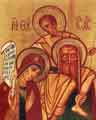 The icon shows the return of the Holy Family from Jerusalem to Nazareth, after the child was lost and found in the Temple. Saint Joseph is carrying Jesus on his shoulders and is looking towards the Virgin Mary, his Mother, who shows him the scroll with the Word of his Mission, where it can be read in Greek the beginning of passage from Isaiah 61, 1-2: "The Spirit of the Lord is upon me, for he has anointed me...". In the face of Saint Joseph appear the physical appearance of the Servant of Yahweh (the Holy Shroud), like a sign that Saint Joseph will prepare Jesus in his mission of the Servant of God who carries upon himself the sins of the world (Is 53). The fact that adolescent Jesus is carried on the shoulders, wants to point out the importance that the father has in the midst of the family in order to introduce the young person into the adult life. The icon shows the necessity which the man has of the family in order to become an adult, the same way by which God has shown it to us through the Holy Family of Nazareth. The fact that Saint Joseph is carrying Jesus on the shoulders is already found, even though rarely, in the ancient iconography tradition, for instance in the mosaics of the church of Cora (12th century), in Istanbul, where, in the return from of Egypt to Nazareth, Saint Joseph carries the Child on the shoulder, and his mother is following. That sight is also found in modern authors; for instance William Dobson (1817-1878) in a painting where Saint Joseph is carrying in his arms the Child Jesus already adolescent in the return to Nazareth, from the meeting with the Doctors in the Temple of Jerusalem (Tate Gallery in London). The fact that the Virgin gives to the Child the Word, can be found and many icons of the Orthodox Church, called "Eleusa Kykkotissa" (Glorious Virgin of Kykko). This name comes from the monastery of Kykko in Cyprus, which conserves and icon attributed to Saint Luke, where it can be seen the Virgin who carries the Child, big already, in her arms and is giving him the scroll of Isaiah. Copies of it can be found in many countries as, for example, in Saint Catherine’s Monastery in Sinai. The great Russian painter Simon Usciakov (16th century) painted a beautiful Kykkotissa that can be seen at Trejakov’s Gallery I in Moscow. The icon measures are 1 x 1.2 meters and was oil painted on oak’s wood covered with gold leaf by Kiko Argüello, initiator of the Neocatechumenal Way, by initiative of the Pontifical Council for the Family in occasion of the II World Meeting of the Families held in Rio de Janeiro (1997). This icon has been donated by the author to the Holy Father. |
|
| Previous WMF's | |
Information about each of the previous WMF's: |
|
| Oración para el V ENCUENTRO MUNDIAL DE LAS FAMILIAS Valencia, Julio 2006 | ||||||||||
OH, Dios, que en la Sagrada Familia nos dejaste un modelo perfecto de vida familiar vivida en la fe y la obediencia a tu voluntad. Te damos gracias por nuestra familia. Concédenos la fuerza para permanecer unidos en el amor, la generosidad y la alegría de vivir juntos. Te pedimos, Señor, que este tiempo de preparación al encuentro mundial de las familias sea un tiempo de intensa experiencia de fe y de crecimiento de nuestras familias. Ayúdanos en nuestra misión de transmitir la fe que recibimos de nuestros padres. Abre el corazón de nuestros hijos para que crezca en ellos la semilla de la fe que recibieron en el bautismo. Fortalece la fe de nuestros jóvenes, para que crezcan en el conocimiento de Jesús. Aumenta el amor y la fidelidad en todos los matrimonios, especialmente aquéllos que pasan por momentos de sufrimiento o dificultad. Derrama tu gracia y tu bendición sobre todas las familias del mundo, especialmente aquéllas que se preparan para el próximo encuentro mundial de las familias en Valencia. Bendice también a nuestro Papa Benedicto. Dale sabiduría y fortaleza, y concédenos el gozo de poderlo recibir en Valencia junto con las familias de todo el mundo. Unidos a José y María, te lo pedimos por Jesucristo tu Hijo, nuestro Señor. Amén. V Encuentro Mundial de las Familias (Valencia, julio 2006) | ||||||||||
| Site search... | ||||||||||
| Forum... | ||||||||||
| Interesting... | ||||||||||
| Album ... | ||||||||||
 | ||||||||||
|


